
Managing HR operations involves much more than maintaining employee records or processing salaries. HR teams also need to keep employee information accurate, track attendance and leave, manage payroll inputs, maintain documents, and follow applicable statutory requirements.
When these activities are handled through separate spreadsheets, registers, and manual processes, HR teams may spend considerable time entering and checking the same information. This can make routine HR work slower and increase the possibility of errors.
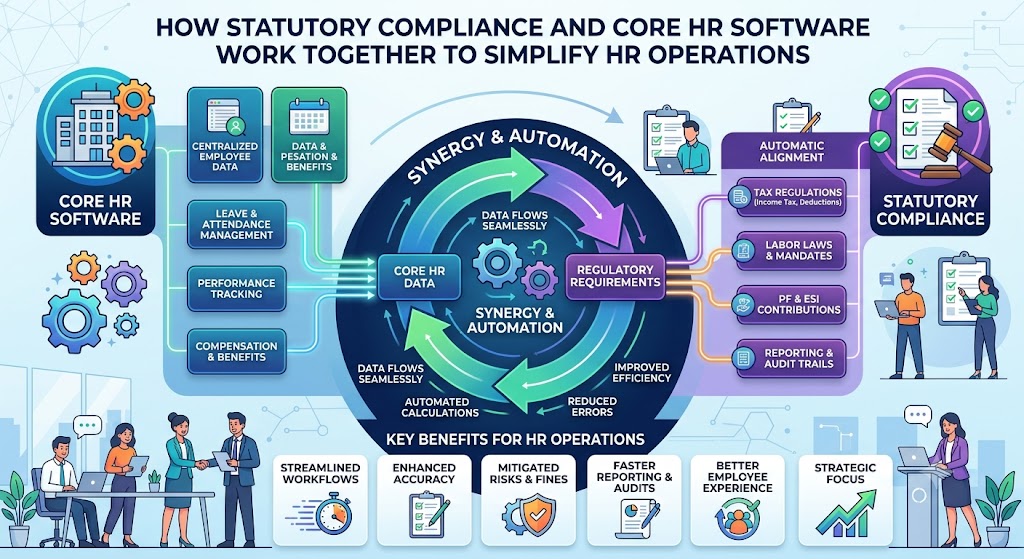
This is where Statutory Compliance and Core HR Software can work together. By connecting employee information with compliance-related processes, organizations can create a more organized HR workflow, reduce repetitive work, and improve visibility across HR operations.
What Is Statutory Compliance and Core HR Software?
The HR technology system known as statutory compliance and core HR software links employee data management with systems that handle all necessary legal requirements.
Organizations use Core HR software to manage their employee database information together with work-related data, attendance records, leave management, organizational structure details, document storage and standard HR operations.
Statutory compliance software helps HR and payroll teams monitor their compliance-related data while performing calculations, maintaining records, and creating reports that follow existing regulations.
The core HR operations send employee information that becomes available for payroll processing and compliance management systems to use. The system lets you keep data updated across multiple systems because it stops duplicate record maintenance.
Why Do Businesses Need Core HR and Statutory Compliance Software?
HR teams need to handle increasing numbers of employees and their associated departments and workplace locations, together with their attendance data, salary records and employee documentation when organizations expand their operations.
The system requires businesses to perform ongoing calculations, make deductions, and maintain records that they must report to comply with regulations.
The manual process of managing these tasks becomes challenging for organizations that operate multiple locations and employ many workers.
HR teams can use an integrated system to store employee data in a single database which enables them to access this information for various HR operations and compliance monitoring.
The system automatically updates HR processes through employee data changes which include salary adjustments, departmental moves and employment status modifications.
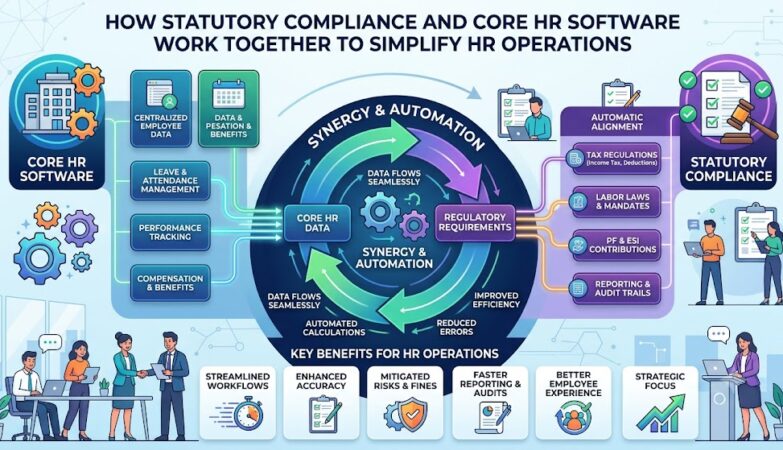
The system workflow shows the following sequence of operations:
Employee Data → Core HR → Attendance and Leave → Payroll Inputs → Statutory Calculations → Compliance Records → Reports
How Do Statutory Compliance and Core HR Software Work Together?
Core HR software functions as a central database that stores employee information, while statutory compliance systems use employee and payroll information to complete their compliance tasks.
The HR and payroll departments need employee data which includes starting employment date, wage details, worksite information, job position and time tracking records for their various operations.
The integrated system allows HR teams to store all information in a single location that connected modules can access for their required data needs.
A typical process may work as follows:
- Employee information is added to the core HR system.
- Employee records are updated when changes occur.
- Attendance and leave information is recorded.
- Relevant payroll inputs are generated.
- Applicable statutory deductions and calculations are processed.
- Compliance-related records and reports are maintained.
- HR teams can review the information through dashboards and reports.
This connected approach can reduce repetitive data entry and make HR processes easier to monitor.
What Are the Key Features of Core HR Software?
The exact features vary between platforms, but core HR software commonly includes functions such as:
- Employee database: The employee database maintains all personnel information which includes employment data together with contact details and additional human resources documentation
- Document management: Helps HR teams maintain employee-related documents in an organized manner.
- Employee self-service: Enables employees to access their information while they can also submit their requests through the system.
- Attendance management: Records employee attendance and working information that may be required for payroll.
- Leave management: Helps employees request leave and enables managers and HR teams to manage approvals.
- Organizational management: Maintains information about departments, designations, reporting structures, and locations.
- Employee lifecycle management: Supports HR activities from onboarding through employee separation.
These functions provide the employee information needed for connected payroll and compliance processes.
What Does Statutory Compliance Software Do?
The software system for statutory compliance enables businesses to handle their regulatory data and operational procedures that follow employment and payroll rules.
The system supports organizations in handling their specific needs through software functions that process statutory deductions, compliance calculations, records and reports, and other related tasks.
The centralized system enables HR and payroll teams to process vital information that they need for running their operations instead of handling each compliance document individually.
Organizations need to set up their software systems based on the specific legal requirements that affect their staff members, business locations, employee types and their payment systems. Organizations need to review their compliance requirements because software solutions fail to guarantee accurate process management systems.
What Are the Benefits of Integrating Core HR and Compliance Processes?
Connecting core HR with statutory compliance can provide several operational benefits.
- Less duplicate data entry: Employee information does not need to be repeatedly entered into different systems.
- Better data consistency: Using centralized employee records can help reduce differences between HR and payroll records.
- Reduced manual work: Routine HR and compliance-related activities can be handled through structured workflows.
- Improved record management: Employee and compliance-related information can be maintained in a more organized manner.
- Faster reporting: HR teams can access relevant information and generate reports without collecting data manually from multiple sources.
- Better visibility: HR and management teams can monitor employee and payroll-related information through centralized dashboards.
- Easier employee management: HR teams can manage employee information, attendance, leave, payroll inputs, and related processes through connected systems.
These benefits become increasingly relevant as workforce size and HR complexity increase.
How Does Integration Help Reduce HR Errors?
The manual HR process requires employees to duplicate data when they move information between their spreadsheet files, payroll records and their compliance documentation. The system creates new data entry points which could lead to incorrect information or old data remaining in the records.
The system will create problems for HR and payroll operations when an employee receives a salary increase but the information does not update across all company systems.
Organizations need Core HR software to store employee information that compliance systems can access through their connection to the centralized employee record database. The system helps organizations remove duplicate records while it provides HR staff with straightforward access to detect data modifications.
The system allows businesses to create automated workflows that handle standard operations but HR staff members must maintain their responsibility to analyze vital documents and monitor regulatory compliance reports.
Can Core HR Software Integrate With Payroll and Statutory Compliance?
Yes, depending on the software and its integration capabilities.
Core HR software can provide employee information to connected payroll and compliance modules. Payroll can then use relevant employee, attendance, leave, and salary information for salary processing and applicable deductions.
The resulting workflow can connect:
Employee Master Data → Attendance → Leave → Payroll → Statutory Deductions → Payslip → Compliance Reports
This type of integration can help HR teams avoid maintaining separate records for every stage of the employee management process.
Before selecting a solution, organizations should check which payroll systems, compliance functions, integrations, and reporting capabilities are supported.
How to Choose the Right Software?
Organizations need to assess their existing HR operations together with their upcoming organizational needs before they select a suitable solution.
Below are the Important factors:
- Employee capacity: The system needs to handle all current employees together with any staff members who will join the organization in the future.
- Core HR functionality: The system should include Core HR functionality because it needs to provide employee records and documents together with attendance and leave management, onboarding and all other essential HR features.
- Compliance capabilities: The system must support all statutory processes that organizations require for their operations.
- Payroll integrations: The system allows HR data to flow automatically into payroll systems without demanding staff members to perform duplicate data entry tasks.
- Reporting: HR teams need the ability to produce reports that contain information about employees, payroll and compliance matters.
- Data security: The platform safeguards employee and payroll data through its built-in security features which protect all stored information.
- Scalability: The system needs to handle growing workforce numbers together with new business units and expanded office locations and additional organizational departments.
- Ease of Use: The system operates with basic user interface elements that let HR administrators, managers and employees access all features through direct menu options.
- Support and implementation: The system provides users with support through its implementation phase and configuration process and all subsequent system operations.
The perfect solution must integrate with the organization’s current HR systems because it should prevent HR staff from building complex systems to link their operations.
End Note:
Overall, the operational link between Statutory Compliance and Core HR Software enables organizations to develop an integrated system that unifies their HR management activities. Core HR software functions as a centralized system that stores employee information, while statutory compliance software enables organizations to handle their essential compliance-related processes and documentation.
Organizations can reduce their administrative work by connecting employee data with attendance and leave records, payroll information, statutory deduction data and reporting systems to create a unified system.
The growing complexity of workforce management requires businesses to unite their core HR operations with compliance systems because this approach enables HR teams to manage employee data more efficiently through organized management systems.
Ready to Simplify Your HR Operations?
Explore how Savvy HRMS can help your organization manage core HR processes, employee information, attendance, payroll, and related HR activities through a connected platform.
Book a free demo today and discover how Savvy HRMS can support more organized and efficient HR management.